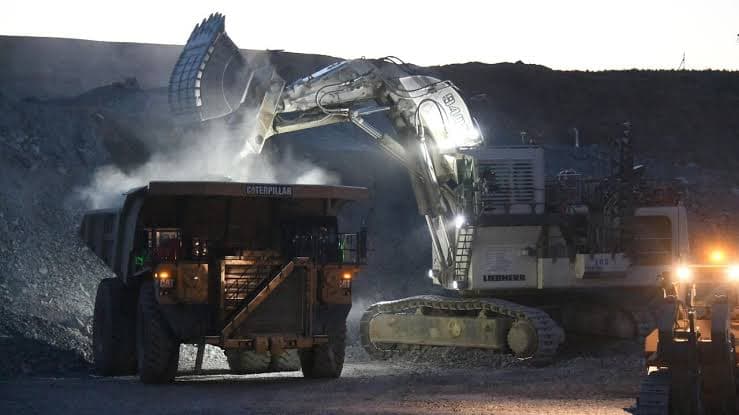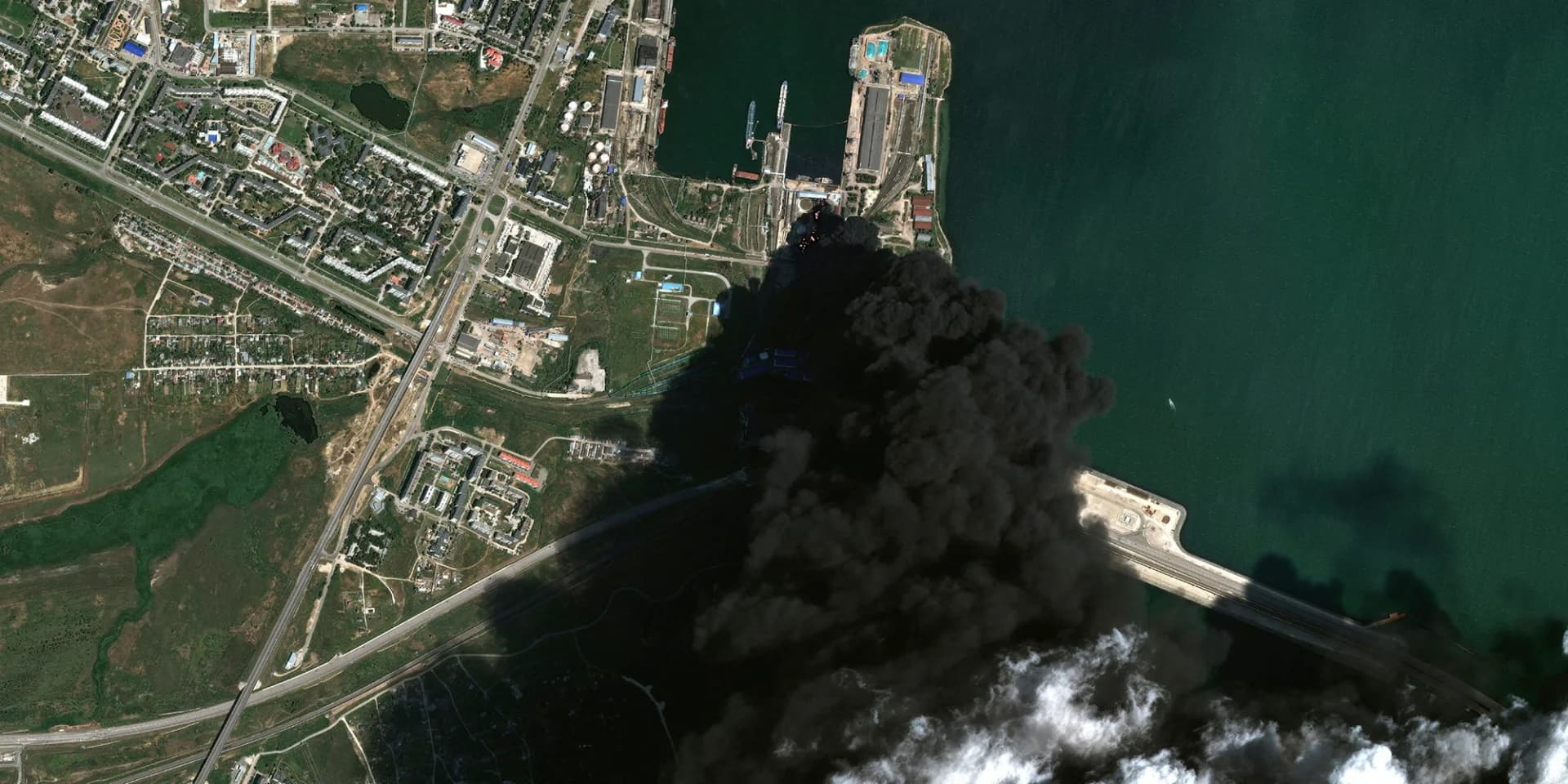
The modern theater of operations is undergoing fundamental changes that, in their scale and impact on military science, can be compared to the transition from sail to steam or to the emergence of carrier-based aviation. The full-scale conflict has crystallized an entirely new battlespace—the water surface and the underwater domain—where autonomous and remotely controlled systems now dominate. A state that, at the initial stage of escalation, was practically deprived of a traditional navy managed to impose its strategic will on an adversary with a vastly larger fleet, completely nullifying classical doctrines of sea power projection.1
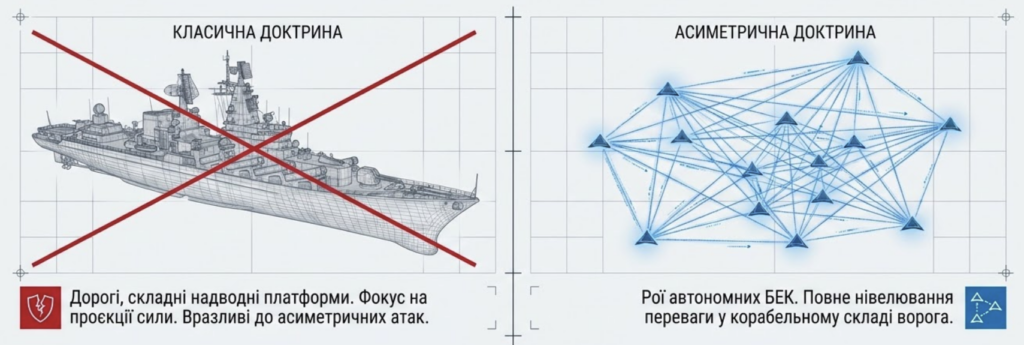
The success of Ukrainian maritime unmanned systems (uncrewed surface and underwater vehicles) against the Russian Federation’s Black Sea Fleet (BSF) has unequivocally demonstrated that asymmetric tactics can disrupt an established balance of power at sea. The use of low-cost, highly maneuverable, and technologically advanced kamikaze drones, which over time evolved into multipurpose robotic platforms, has opened a new era in which expensive and maintenance-intensive surface combatants become vulnerable targets.3
Strike Statistics
The effectiveness of Ukrainian maritime unmanned systems is measured by the direct economic damage inflicted on the enemy fleet. As of early 2026, approximately 30% of the Russian Black Sea Fleet’s combat inventory had been destroyed or critically damaged.1 As a result of these losses, the Russian fleet effectively lost its offensive potential and was forced to adopt a strategy of passive survival, relocating its most valuable naval assets from the temporarily occupied Crimean Peninsula to Novorossiysk.1
Scale of Losses in Russian Naval and Air Assets
As of 17 May 2026, according to official data from the General Staff of the Armed Forces of Ukraine, total Russian military losses had reached approximately 1,348,790 personnel.6 In addition to colossal manpower losses, 11,938 tanks, 24,578 armored combat vehicles, 42,215 artillery systems, and 295,454 operational-tactical unmanned aerial vehicles were destroyed.6 However, the most illustrative figures are the losses at sea and in the air: 33 Russian military ships and boats destroyed, 2 submarines, 436 aircraft, and 352 helicopters.6
In just 18 months of intensive combat operations, MAGURA V5-type maritime drones successfully struck 18 Russian vessels.9 The Group 13 special unit of the Main Directorate of Intelligence (HUR) of the Ministry of Defence of Ukraine inflicted losses on the Russian Navy exceeding USD 500 million.10 An analysis of key losses demonstrates the evolution of targets and the expanding range of Ukrainian unmanned systems.
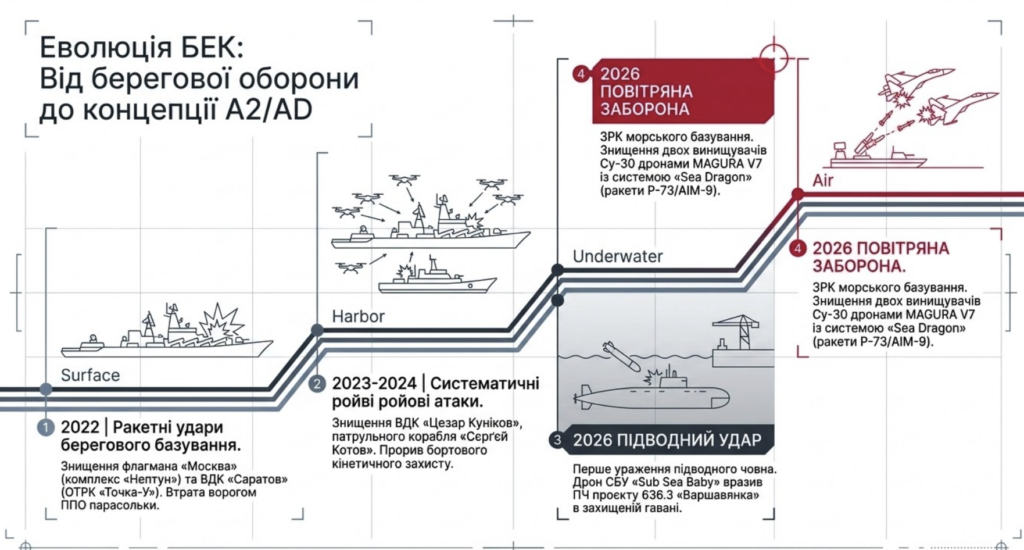
The first major loss was the large landing ship Saratov, destroyed in the port of temporarily occupied Berdiansk in March 2022 by a Tochka-U ballistic missile. This was a unique case of a ground-launched missile being used against a naval target and it disrupted the enemy’s plans to land an amphibious assault force.1 Later, in April 2022, the flagship of the Russian Black Sea Fleet, the missile cruiser Moskva, was sunk by Ukrainian Neptune anti-ship missiles.1 The destruction of this cruiser was of fundamental importance, as it provided air defense cover for the entire ship group through S-300F systems; without this protective “umbrella,” Russian ships became critically vulnerable to aviation and surface drones, which ultimately led to the de-occupation of Snake Island.1
Subsequently, Ukrainian maritime drones moved to the systematic destruction of the enemy fleet. The large landing ships Caesar Kunikov and Novocherkassk were destroyed in combined attacks, which finally eliminated the enemy’s logistical and amphibious capabilities in the south.11 The missile boat Ivanovets and the patrol ship Sergey Kotov were hit directly by swarms of MAGURA V5 drones, demonstrating the ability to effectively overcome ships’ onboard kinetic defenses.11 In May 2026, the geography of strikes expanded unprecedentedly: Ukraine’s Unmanned Systems Forces (USF) struck a Project 10410 Svetlyak-class patrol ship and a small missile ship directly at the naval base in Kaspiysk (Dagestan, Caspian Sea), located almost 1,000 kilometers from the front line.5 Moreover, the underwater domain also ceased to be safe: an underwater drone of the Security Service of Ukraine called Sub Sea Baby, in the first such case in naval warfare history, struck a Russian Project 636.3 Varshavyanka-class submarine (Kilo class) inside the protected harbor of Novorossiysk, elegantly bypassing boom barriers and executing a complex maneuver within the base’s waters.14
Integration of Air Defense Systems
A revolutionary technological breakthrough in 2025–2026 was the expansion of Ukrainian maritime drones’ functionality to include air defense missions. For a long time, Russian forces used Ka-27 and Mi-8 helicopters and Su-30 fighters to patrol the waters and shoot down Ukrainian uncrewed surface vessels (USVs) from the air.16 In response, Ukrainian developers successfully integrated air-to-air missiles onto maritime platforms, creating sea-based surface-to-air missile systems.
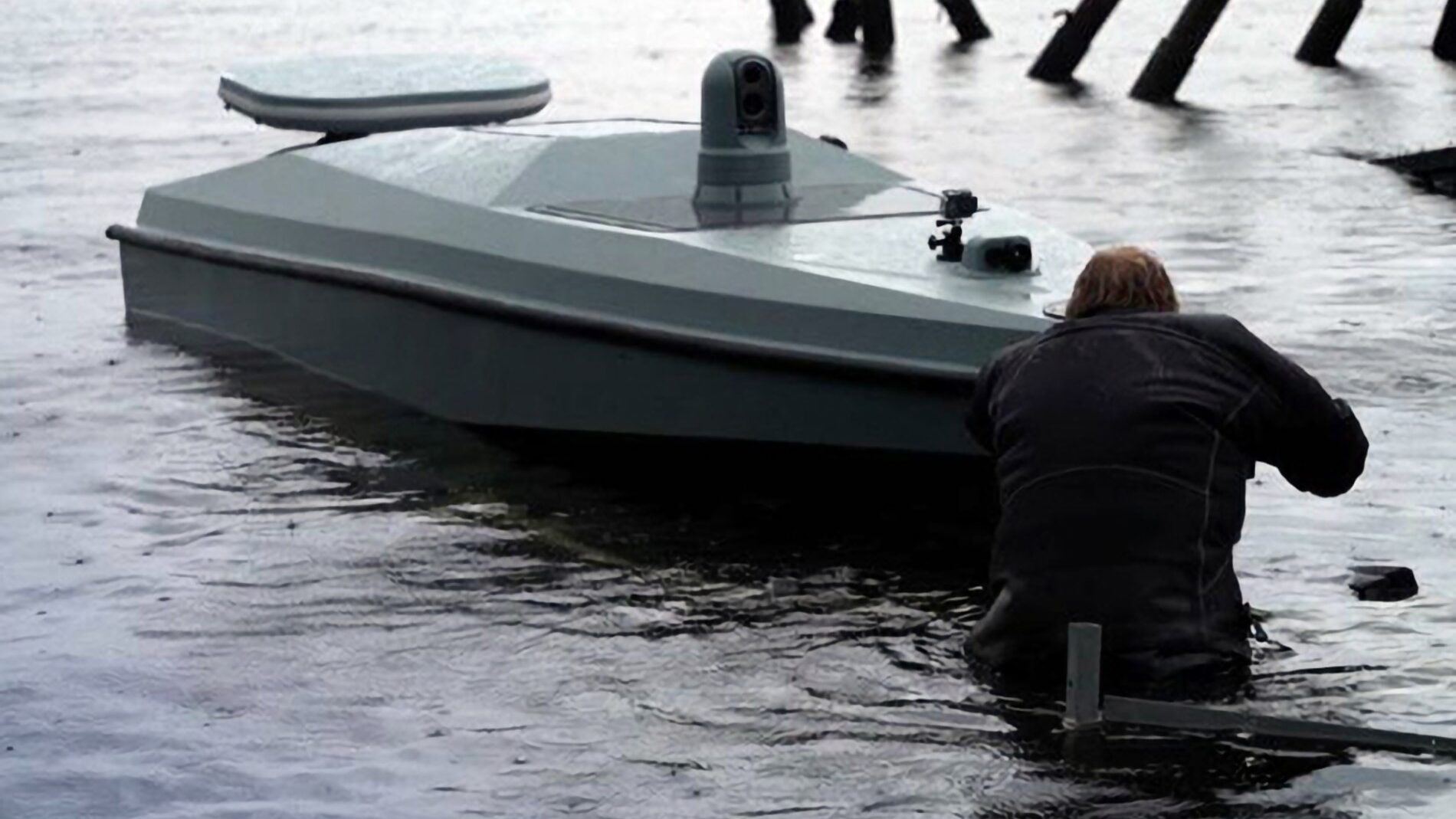
This innovation produced results on 31 December 2024, when a MAGURA V5-type drone shot down two Russian Mi-8 helicopters for the first time in history.18 This trend continued: during an attack on the military airfield in Yeysk in May 2026, a Ka-27 helicopter and a Be-200 amphibious aircraft were hit.5 However, the most significant achievement was the destruction of two Russian Su-30 multirole fighters (Flanker) in May 2026 using a modified MAGURA V7 drone.11 This platform was equipped with the Sea Dragon system—an air-defense module based on adapted R-73 missiles or American AIM-9 Sidewinder missiles.11 The use of infrared-guided missiles with high-off-boresight target acquisition capability made it possible to compensate for wave-induced motion and the absence of a sophisticated radar station.21 This data unequivocally demonstrates that maritime drones have evolved from an instrument of asymmetric coastal defense into a strategic means capable of conducting anti-access and area denial (A2/AD) operations both on the water surface and in the airspace above it.
The Economics of Future Warfare
The principal catalyst for the success of robotic systems is the colossal economic asymmetry that completely changes the paradigm of what constitutes a “cost-effective” military operation. Security experts define this phenomenon as the “$4 Million Hole” — a situation in which modern armed forces are forced to use a high-tech surface-to-air missile (for example, a Patriot interceptor costing USD 4 million) to destroy a primitive Shahed-type strike drone that costs no more than USD 20,000–35,000.3
If an air defense system even demonstrates 100% effectiveness during a mass attack of 50 drones, the cost of defense reaches USD 200 million compared with USD 1 million spent on the attack.4 In a war of attrition, the side that spends millions to stop thousands inevitably faces strategic bankruptcy.4 An analogous, but even more destructive, economic logic applies at sea.
Cost Ratio
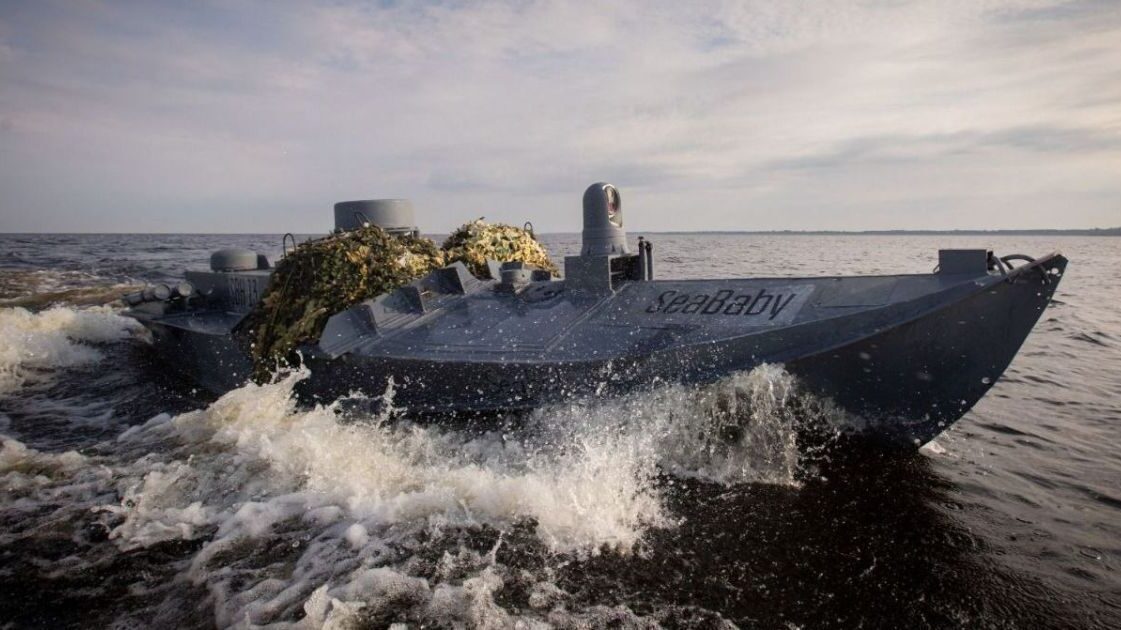
The estimated cost of modern Ukrainian strike uncrewed surface vessels varies depending on the specific modification and integrated payload. The base cost of the Sea Baby platform is estimated at approximately USD 200,000–221,000.22 The more specialized MAGURA V5 system has an estimated cost of USD 273,000.19 Notably, these figures appear highly competitive even compared with procurement by Western partners. By comparison, the UK Ministry of Defence ordered 20 uncrewed boats (likely of the K3 Scout type from Kraken Technology) for a total of USD 16.4 million, or about USD 821,000 per unit, although the British boats have less combat experience than their Ukrainian counterparts (it should be noted that this amount includes control stations, crew training, and technical support).23
On the other hand, the value of the targets systematically destroyed by Ukrainian drones is higher by several orders of magnitude. The destroyed missile boat Ivanovets is estimated at approximately USD 60–70 million. A Su-30 fighter destroyed by a maritime drone costs about USD 50 million.19 Modern Russian Project 22350 frigates (such as Admiral Gromov, the construction of which began in May 2026 at the Severnaya Verf shipyard in St. Petersburg) cost the Russian budget between 500 billion and 1 trillion rubles, equivalent to USD 5–10 billion, taking into account inflation and the cost of weapons and carrier-based aviation.24
Thus, the cost ratio of deploying a swarm of even ten maritime drones to the value of a modern frigate struck is an extraordinary 1:2000. In the conditions of the contemporary global economy, such an imbalance makes further development of large fleets in their classical sense economically impractical for most states.
Problems in Russian Shipbuilding Programs
Despite the obvious changes in the nature of naval warfare, the Russian Federation’s doctrinal reliance on large surface platforms persists, but it faces critical challenges. According to plans for 2024–2030, the Russian Navy continues to rely on Project 22350 frigates (with increased displacement and a doubled ammunition load) and Project 23900 Ivan Rogov universal landing ships, which are an attempt to replace the French Mistrals.24 Russian President V. Putin announced the allocation of 8.4 trillion rubles (more than USD 100 billion) for the implementation of a long-term shipbuilding program through 2050.26
However, implementation of these programs is being slowed by harsh international sanctions and the technological degradation of the Russian military-industrial complex. Despite statements by the leadership of Russian shipbuilding corporations that the impact of sanctions is allegedly imperceptible, Russian industry is critically dependent on imports of Western radio-electronic components and modern machine-tool technologies.27 The long construction cycle for large ships, measured in many years and constantly accompanied by significant budget overruns 29, stands in sharp contrast to Ukraine’s ability to mass-produce hundreds of maritime drones each month, adapting their designs literally within days.30
Evidence that the Russian naval command fully understands the drone threat is the introduction of emergency protective measures on strategic assets. Even at the Rybachiy submarine base of the Pacific Fleet on the Kamchatka Peninsula—7,400 kilometers from the theater of operations in Ukraine—the latest Project 955A Borey-A nuclear-powered ballistic missile submarines began to be widely covered with anti-drone nets.31 This is direct proof that fear of asymmetric attacks is forcing the fleet to adapt its defenses even deep in the rear, where the appearance of drones was previously considered impossible.
Artificial Intelligence and Communications Systems
The integration of advanced communications systems and artificial intelligence (AI) algorithms is the nerve center that allows maritime drones to function as a single coordinated organism. The water environment is extremely difficult for data transmission, requiring convergence of aerospace satellite and deep-water acoustic technologies.
Surface Navigation
In the early stages of the conflict, Ukrainian uncrewed surface vessels relied almost exclusively on Starlink satellite communications terminals, which provided high-speed two-way data transmission and allowed operators to control drones in real time in first-person view (FPV).32 However, absolute dependence on commercial providers carries significant strategic risks. For example, it became known that the Russian Federation planned a large-scale offensive campaign using its own maritime drones in early 2026.28 However, these plans collapsed because SpaceX, at the request of the Ukrainian government, blocked Russian terminals’ access to the Starlink network.28 Russian attempts to switch to alternative or domestic communications systems proved futile because of their technological inability to transmit heavy video data streams under conditions of active electronic warfare (EW).28
To avoid such vulnerability, modern Ukrainian MAGURA and Sea Baby variants use backup communications channels, including Kymeta systems and mesh-network technologies employing aerial UAVs as relays.32 In addition, the Ukrainian MAGURA V7 drone can itself serve as a communications carrier and relay for launching a swarm of quadcopters directly at sea, significantly expanding the area of operational control.34
Artificial Intelligence
Given the continuous improvement of enemy EW systems and GPS/GNSS signal jamming 35, the key development vector has become the full autonomy of maritime drones through AI. A vivid example is the development and installation on the Magura V7 platform of the “Bullfrog” intelligent automated turret, created in partnership with the American company Allen Control Systems.36
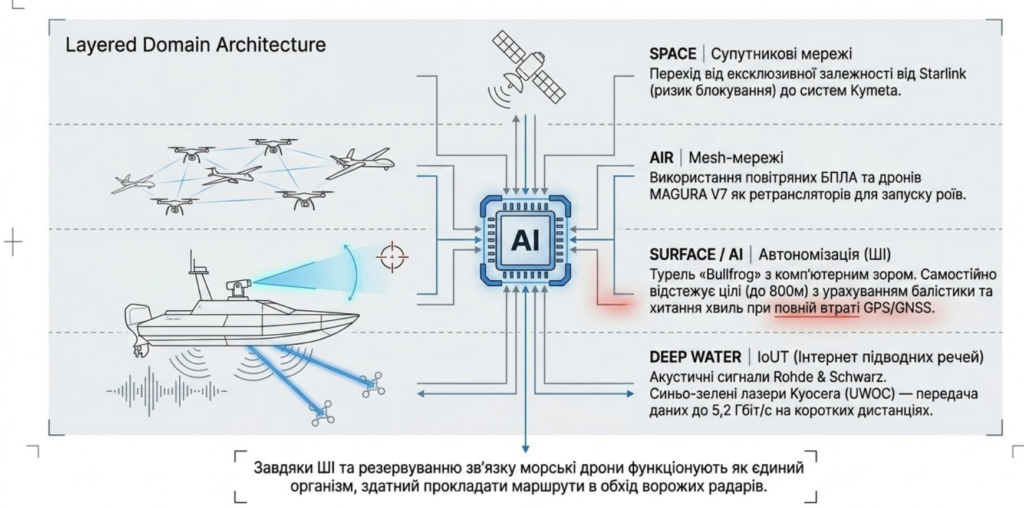
This AI-based system is capable of independently identifying, tracking, and locking onto aerial targets (for example, Shahed-type strike UAVs) and engaging them with heavy machine guns (M240, M2, M134) at an effective range of up to 800 meters.36 Using computer vision algorithms, the system calculates ballistic corrections, taking into account wave motion and target speed, and makes destruction decisions with minimal human operator intervention.36 This approach ensures mission accomplishment even in the event of complete loss of satellite communications within the range of enemy EW systems. At the strategic level, AI also analyzes satellite imagery, intercepted data, and open-source information to create complex multilayer battlefield maps, plotting optimal drone routes that bypass enemy radars and patrols.38
Latest Technological Breakthroughs
Controlling underwater drones faces an insurmountable physical obstacle: the water column absorbs electromagnetic waves, making traditional radio communication impossible.40 Historically, this forced reliance on slow acoustic modems. However, in 2025–2026 the industry made an unprecedented leap forward.
Companies such as Germany’s Rohde & Schwarz developed cutting-edge software-defined acoustic waveforms that provide low-latency, high-bandwidth communication with an extremely low probability of detection or interception by the enemy.41 This allows underwater vehicles to exchange tactical data both among themselves (forming an underwater swarm) and with surface relays.
An even more significant breakthrough was underwater wireless optical communication (UWOC) based on blue-green lasers. At CES 2026, Japanese corporation Kyocera demonstrated a system capable of transmitting data underwater at speeds of up to 5.2 Gbps.43 Although this technology is limited to ranges of several dozen meters, it allows autonomous underwater vehicles (AUVs) to instantly exchange high-resolution video and sensor data when approaching one another or a docking station, which is critical for both military reconnaissance and inspection of maritime infrastructure.44 The convergence of these technologies forms the architecture of the “Internet of Underwater Things” (IoUT), which will provide total situational awareness in the hydrosphere.46
Technical Characteristics of Advanced Maritime Platforms
The evolution of Ukrainian uncrewed systems from improvised “boats with explosives” into full-fledged multipurpose combat platforms took place in record time.47 To understand the architecture of the modern maritime battlespace, it is necessary to examine in detail the characteristics of the dominant systems as of 2026.
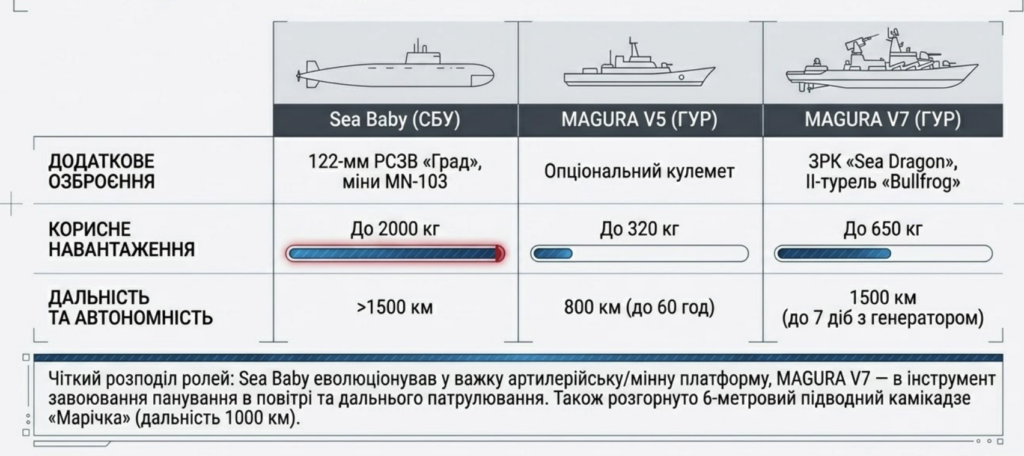
Analysis of the technical specifications indicates a clear division of roles between the platforms. Sea Baby has evolved into a heavy strike-artillery and mine-laying platform. Increasing the payload to 2 tons and installing a 122 mm multiple launch rocket system (“Grad”) allows this drone not only to ram targets but also to conduct massed strikes against coastal infrastructure, air defense positions, and ships moored in harbor.49
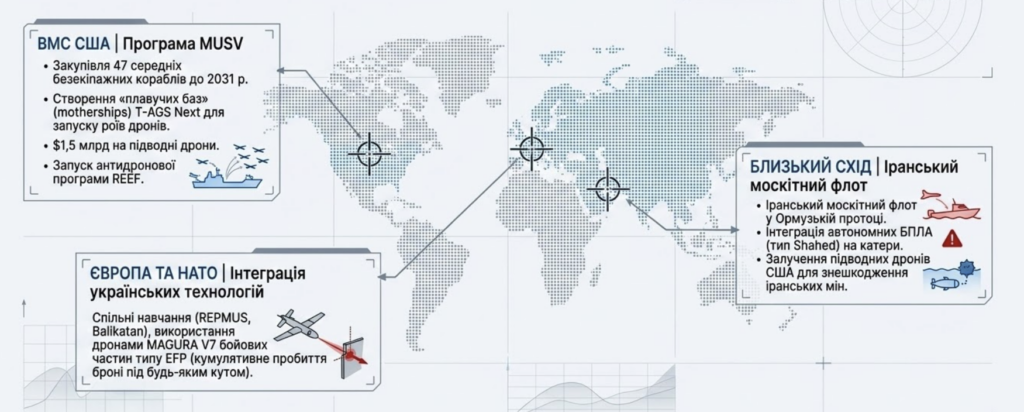
At the same time, the MAGURA family, especially the V7 variant, has become a high-tech instrument for achieving air superiority and conducting long-duration patrols. The enlarged hull dimensions (up to 8 meters) significantly improved seaworthiness, allowing MAGURA V7 to operate effectively in wave heights of up to 3 meters and remain at sea autonomously for up to 7 days thanks to the integration of a diesel generator.11 Arming this drone with the Sea Dragon air-defense system using AIM-9 Sidewinder missiles makes it a lethal threat to enemy aviation, as demonstrated by the destruction of Su-30 fighters.20 In addition, during joint NATO exercises such as REPMUS in Portugal or Balikatan 2026 in the Philippines, MAGURA V7 demonstrated the use of a new EFP-type warhead (explosively formed penetrator), which provides a directed shaped-charge jet for guaranteed penetration of ship armor at any angle of attack.53 The underwater kamikaze drone Marichka, 6 meters long with a range of 1,000 km, has also entered service; it can lie on the seabed awaiting a target and attack ships at their most vulnerable underwater section.54
Kronos Submarine: Prospects for Nuclear Deterrence
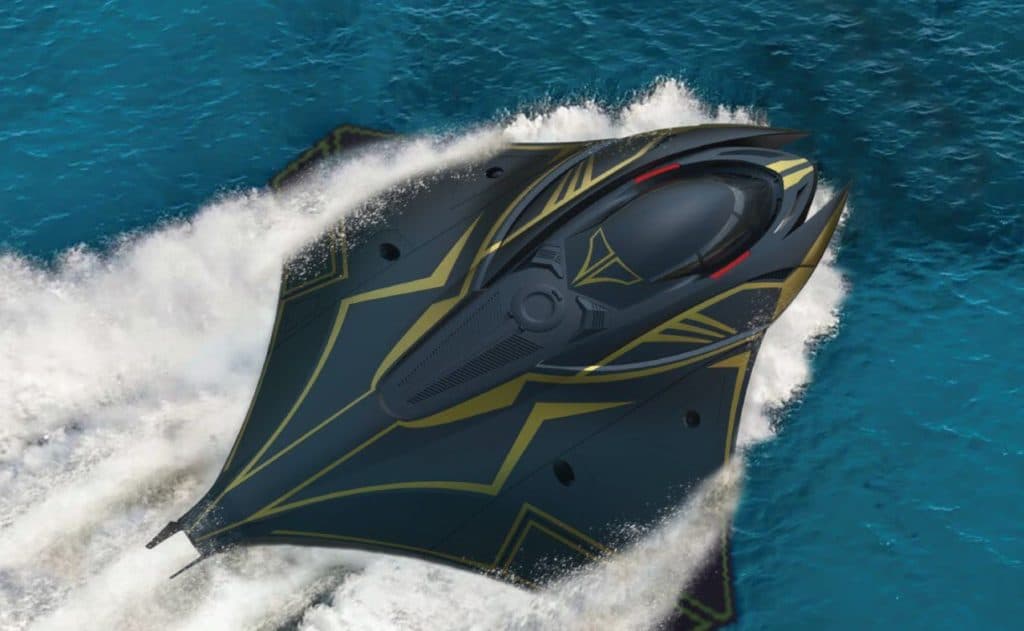
The logical next step in the evolution of maritime unmanned systems is the transfer of combat operations from the surface to the underwater domain, where platforms are less vulnerable to visual observation, radar, and weather conditions.55 The conceptual embodiment of this trend is the Kronos strike submarine platform, developed in the UAE by Highland Systems, a company founded by Ukrainian engineers (chief designer: Oleksandr Kuznetsov).56
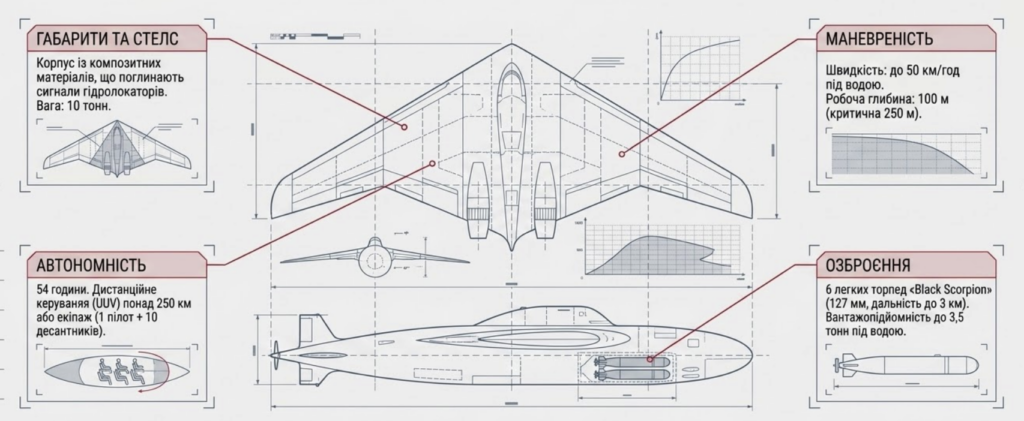
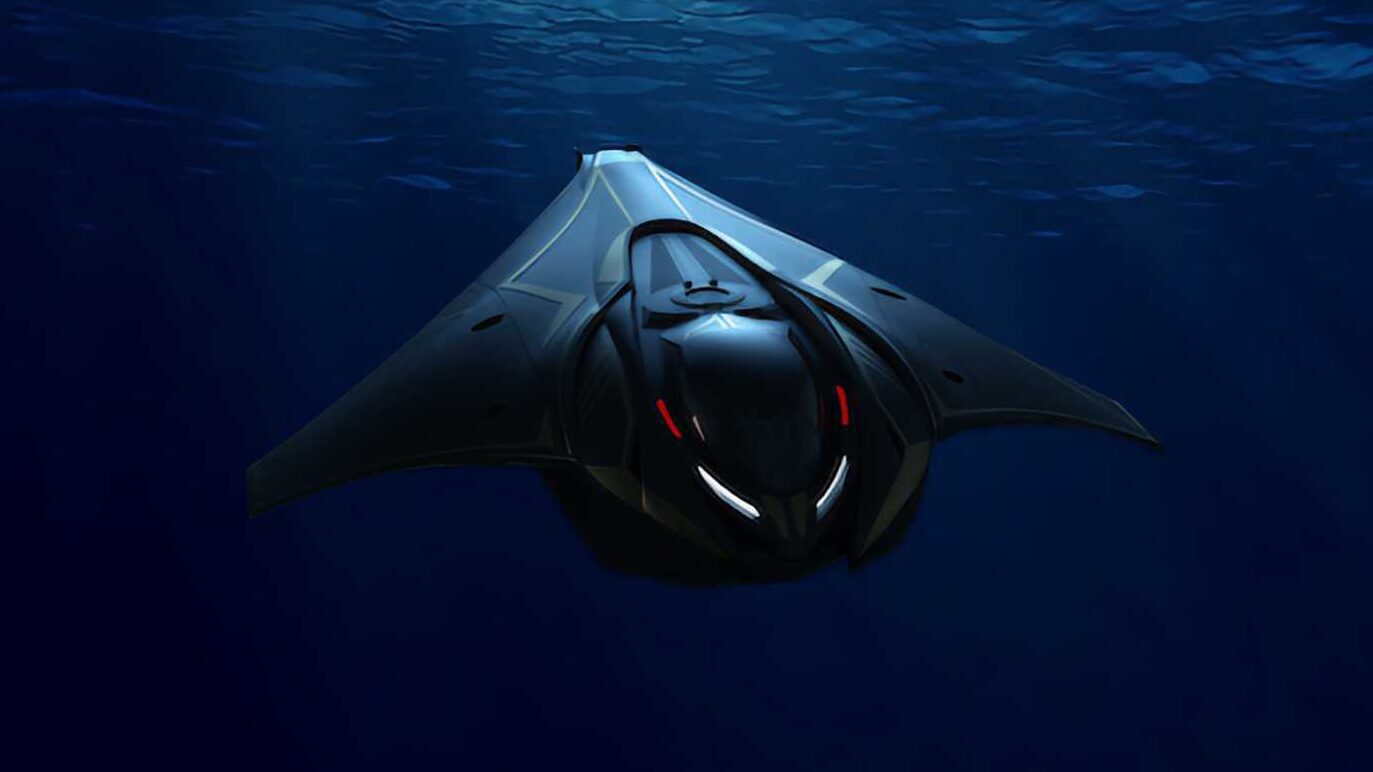
The Kronos hybrid armored submarine project features a futuristic hydrodynamic design resembling a “flying wing” or the shape of a diamond-shaped manta ray. The hull, made of advanced dark composite stealth materials that absorb sonar signals, conceals a “bubble” cockpit, folding wings for convenient transport, and compartments for torpedo armament.58 Thanks to this innovative architecture, the submarine is capable of maneuvering underwater with the agility of a fighter jet, fundamentally differing from cumbersome classical submarines.56
Key tactical and technical characteristics of Kronos:
- Dimensions: Width 7.43 m, length 9.02 m, height 2.08 m; mass 10 tons.62
- Speed: Up to 50 km/h (27 knots) underwater, 80 km/h on the water surface.60
- Diving depth: Operating depth 100 meters, critical depth 250 meters.60
- Endurance: 54 hours in hybrid mode, 36 hours on a diesel generator, 18 hours on batteries.60
- Payload and crew: Capable of functioning as a fully uncrewed drone (UUV), remotely controlled from over 250 km away, or transporting 1 pilot and 10 assault troops; total payload up to 3.5 tons underwater.58
- Armament: An integrated system of 6 Black Scorpion light torpedoes (developed by the Italian company Leonardo) with a diameter of 127 mm, capable of striking targets at a range of up to 3 km.56
The tactics for using such platforms involve covert approach to enemy bases, lying on the ocean floor in a waiting mode (like a predator), and delivering lightning torpedo strikes against ship hulls or attaching magnetic mines.58 As experts at the U.S. Naval College note, the Kronos concept makes sabotage operations and attacks on fleet anchorages extremely effective, nullifying the kinetic protection of surface vessels.58
Integration of Tactical Nuclear Weapons
The ability of modern underwater and surface drones (such as Sea Baby or Kronos) to covertly deliver payloads weighing from 1 to 3.5 tons opens entirely new and dangerous strategic horizons in the context of weapons of mass destruction. In theory, these platforms possess ideal characteristics for carrying miniature nuclear warheads.
From an engineering perspective, the miniaturization of nuclear weapons has long been a reality. A historical precedent is the American W54 tactical nuclear warhead, developed in the late 1950s. Weighing just over 20 kg, this warhead could easily fit into the backpack of a saboteur-paratrooper (the SADM system) and delivered an explosive yield of 10 to 1,000 tons of TNT equivalent.65 Modern technologies make it possible to create even more compact warheads. Integrating such a munition into the hull of an underwater glider or an uncrewed surface vessel with stealth technologies is not fundamentally technically difficult.67
States are already working in this direction. The Russian Federation has created the giant autonomous Poseidon torpedo (Status-6) with a nuclear power plant and a multi-megaton warhead intended to destroy entire coastal megacities.69 North Korea is also testing its own Haeil-class nuclear underwater drone, capable of triggering radioactive tsunamis.71
However, the creation of a “mosquito fleet” equipped with miniature tactical nuclear warheads completely destroys the traditional architecture of global security. The modern doctrine of nuclear deterrence and mutually assured destruction (MAD) relies on expensive, visible, and controllable strategic platforms: ballistic missile submarines (SSBNs), bombers, and launch silos.72 A swarm of dozens of autonomous underwater gliders pre-deployed near key maritime chokepoints or enemy naval bases (acting as highly intelligent “sleeping” mines with nuclear payloads) could inflict sudden guaranteed destruction on carrier strike groups before the enemy has time to initiate a response procedure.72 Given the low production cost of such drones, even small or economically weak states (or non-state actors) would theoretically gain access to a nuclear delivery tool that is almost impossible to detect by satellite reconnaissance, creating an existential threat to the entire world.72
New Doctrines in the West and the East
The Ukrainian experience has not gone unnoticed. Governments around the world are urgently revising their naval budgets, recognizing that the era of large ships dominating without robust protection is over.
Iranian Mosquito Fleet
The “mosquito fleet” strategy is not entirely new: its beginnings were laid by Iran in the 1980s during the Tanker War. After devastating defeats by the U.S. Navy, the Islamic Revolutionary Guard Corps (IRGC) abandoned a classical fleet in favor of thousands of speedboats equipped with machine guns, recoilless guns, and light anti-ship missiles.91 This fleet relies on swarm tactics, in which dozens of small boats attack a large destroyer from multiple directions, overwhelming its radar systems and close-in weapons. Although Iranian boats are mostly crewed, the integration of autonomous unmanned systems and kamikaze drones (similar to Shahed-136, adapted for maritime use) makes the Strait of Hormuz one of the most dangerous arteries in the world for global trade.92 Defending against this threat forced the U.S. and British navies in 2026 to initiate the REEF program (Robotic Exclusion & Engagement Framework), aimed at developing systems for early detection and destruction of autonomous threats in port waters.94 The United States is also compelled to deploy underwater drones to neutralize Iranian mines in the strait, reducing risks to divers.95
U.S. Navy Robotization Programs
The U.S. Navy has responded to the new reality with a major adjustment of its shipbuilding plans. While classic cruisers and aircraft carriers remain the basis of power projection, dangerous forward missions are being assigned to machines. According to the 30-year shipbuilding plan through 2056 (2026 update), the U.S. Navy plans to procure 47 medium uncrewed surface vessels (MUSVs) by 2031 and increase the number to 72 by 2056.97 In the 2027 budget request, the Pentagon also included the Next Generation Oceanographic Survey Ship (T-AGS Next) — which will serve as a “mothership” intended exclusively for transporting, coordinating, and launching swarms of underwater, surface, and aerial drones.98 Budgets for autonomous technologies are growing exponentially: more than USD 2.1 billion has been allocated to uncrewed surface vessels, USD 1.5 billion to loitering munitions, and USD 1.5 billion to underwater drones (UUVs).99
Ukraine’s Global Leadership:
With unique combat experience, Ukrainian companies are becoming global leaders in the export of unmanned technologies. It is projected that the volume of Ukrainian defense-industrial exports could reach USD 2 billion as early as 2026, with potential growth to USD 10 billion annually over the next five years.100 Ukraine is successfully concluding international “Drone Deal” agreements. In particular, Italy has entered the top four importers of Ukrainian technologies, investing EUR 349 million in defense contracts aimed at exchanging experience in UAVs and electronic warfare systems.101
At the same time, President V. Zelensky has begun intensive negotiations with Middle Eastern countries (Saudi Arabia, the UAE, Qatar), which urgently need drone-interception systems (hunter drones) to protect their oil infrastructure and tankers from Iranian attacks. Ukrainian systems, capable of efficiently and cheaply destroying Shaheds using equally inexpensive FPV interceptors, have become an ideal solution for Gulf states.30 It is expected that from 2026 onward, a network of export hubs for promoting Ukrainian technologies will operate across Europe.102
Civilian Applications:
Although the primary task of drones remains national security, their mass production, cheaper components, and improved AI algorithms create enormous potential for the civilian sector.
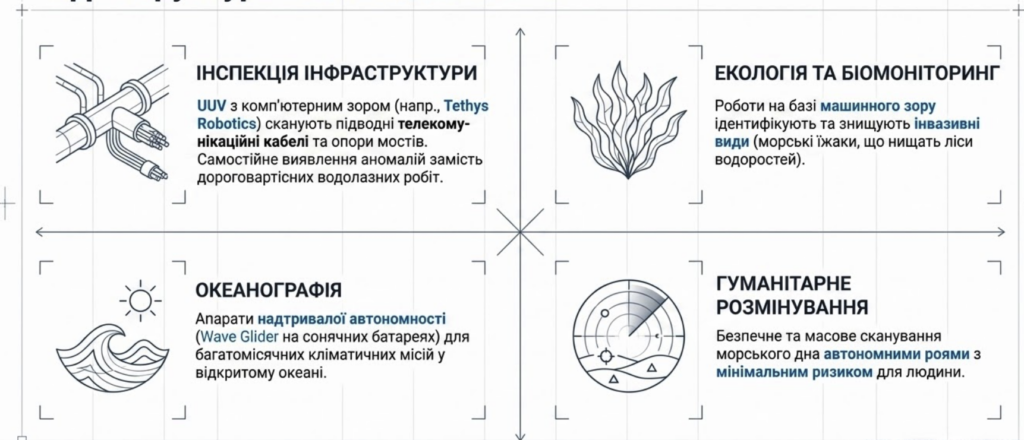
- Inspection of underwater infrastructure: Intelligent underwater vehicles are being actively deployed to inspect pipelines, offshore wind farms, underwater telecommunications cables, and bridge supports.39 Whereas in the past it was necessary to hire expensive vessels or deploy divers to search for damage on an ocean cable, today autonomous UUVs with computer vision can independently scan the object, detect anomalies, and transmit coordinates directly to rescue teams.107 Companies such as Switzerland’s Tethys Robotics are developing ultra-compact underwater drones that function even in difficult conditions such as fast river currents or poor visibility.108
- Ecology and oceanography: Unmanned systems monitor ecosystems, study water pollution levels, and combat invasive species. For example, specialized underwater robots (based on Raspberry Pi computers), using machine vision, have learned to identify and physically remove invasive purple sea urchins that destroy kelp forests off the coast of California.105 Long-endurance technologies such as solar-powered and wave-powered gliders (Wave Glider) are used for multi-month climate and meteorological missions in the open ocean, monitoring temperature and salinity levels.109
Conclusions
An analysis of the transformation of modern naval warfare up to 2026 leads to an unequivocal conclusion: the era of the unquestioned dominance of massive, extremely expensive, and sluggish military platforms (such as missile cruisers, battleships, or heavy frigates) is definitively coming to an end. Ukraine’s successful use of maritime unmanned vehicles (MAGURA, Sea Baby) against the Russian Black Sea Fleet has demonstrated that an intelligent “mosquito fleet,” relying on the integration of AI algorithms, backup satellite networks, and acoustic communications, can paralyze any classical naval group.
The critical economic asymmetry—when the means of destruction costs thousands of times less than its target—makes traditional shipbuilding programs prohibitively burdensome for budgets. The successful adaptation of air-defense systems (such as Sea Dragon) and multiple launch rocket systems aboard light boats completely erases the boundary between asymmetric defense and full-fledged offensive power. Moreover, the development of hybrid underwater platforms such as the armored Kronos submarine, and the theoretical possibility of equipping them with miniaturized tactical nuclear warheads, threaten the entire global architecture of nuclear deterrence. This colossal leap in military innovation, now being exported by Ukraine to the Middle East and NATO countries, is already becoming the foundation for peaceful technologies of the future—from humanitarian demining to the exploration of the ocean depths—forming the infrastructure of a new global “blue economy.”
Institute for Social Dynamics and Security KRONOS
OSINT tools and artificial intelligence were actively used in the investigation, including the Gemini and Grok models. OSINT methods made it possible to collect and analyze open data from various sources, including social media, public databases, and web resources. Gemini provided in-depth analysis of textual data, pattern detection, and forecasting, while Grok, created by xAI, was used to process complex queries and generate precise conclusions based on large volumes of information. The combination of these technologies significantly accelerated the investigation process, improved the accuracy of the results obtained, and revealed connections that might have remained unnoticed by traditional methods.
Sources
- A sinking fleet: russia’s largest losses in the Black Sea and the Sea of Azov during the war, https://mod.gov.ua/en/news/a-sinking-fleet-russia-s-largest-losses-in-the-black-sea-and-the-sea-of-azov-during-the-war
- Fleet in decline: Russia’s biggest naval losses in the Black and Azov Seas, https://odessa-journal.com/fleet-in-decline-russias-biggest-naval-losses-in-the-black-and-azov-seas
- Calculating the Cost-Effectiveness of Russia’s Drone Strikes – CSIS, https://www.csis.org/analysis/calculating-cost-effectiveness-russias-drone-strikes
- The End Of Traditional Warfare: How Cheap Drones And Missile Strategy Are Defeating Superpower Tech – OpEd – Eurasia Review, https://www.eurasiareview.com/08042026-the-end-of-traditional-warfare-how-cheap-drones-and-missile-strategy-are-defeating-superpower-tech-oped/
- Ukrainian Strikes Hit Russian Missile Boat, Minesweeper and Major Oil Refinery Overnight, https://united24media.com/war-in-ukraine/ukrainian-strikes-hit-russian-missile-boat-minesweeper-and-major-oil-refinery-overnight-18856
- Russia loses 1,170 soldiers and 82 artillery systems over past day, https://www.pravda.com.ua/eng/news/2026/05/17/8035017/
- Daily Update: Russia Loses 1,170 Troops, Three Air Defense Systems and One Aircraft in One Day, https://united24media.com/war-in-ukraine/daily-update-russia-loses-1170-troops-three-air-defense-systems-and-one-aircraft-in-one-day-18883
- russian losses in Ukraine as of May 17, 2026 | MoD News, https://mod.gov.ua/en/news/total-russian-combat-losses-in-ukraine-as-of-may-17-2026
- MAGURA V5 drones hit 18 Russian vessels in 18 months – Ukrinform, https://www.ukrinform.net/rubric-ato/3895752-magura-v5-drones-hit-18-russian-vessels-in-18-months.html
- First Look at Ukraine’s Magura Sea Drones That Destroyed 15 Russian Targets, https://united24media.com/latest-news/first-look-at-ukraines-magura-sea-drones-that-destroyed-15-russian-targets-8394
- Ukrainian Intelligence Unveils Magura V7 Sea Drone with Air Defense Capabilities, https://en.defence-ua.com/news/ukrainian_intelligence_unveils_magura_v7_sea_drone_with_air_defense_capabilities-14522.html
- List of ship losses during the Russo-Ukrainian war – Wikipedia, https://en.wikipedia.org/wiki/List_of_ship_losses_during_the_Russo-Ukrainian_war
- Ukraine hits its fourth Russian ship of the mounth in the Caspian Sea, this time an FSB border patrol boat – Euromaidan Press, https://euromaidanpress.com/2026/05/17/ukraine-hits-its-fourth-russian-ship-of-the-mounth-in-the-caspian-sea-this-time-an-fsb-border-patrol-boat/
- Analyst explains how Ukrainian underwater drone struck Russian Kilo-class submarine, https://english.nv.ua/russian-war/analyst-explains-how-ukrainian-underwater-drone-struck-russian-kilo-class-submarine-50568845.html
- SBU’s underwater drone ‘Sub Sea Baby’ hit a Russian submarine of the 636 Varshavyanka class. : r/ukraine – Reddit, https://www.reddit.com/r/ukraine/comments/1pn9qgq/sbus_underwater_drone_sub_sea_baby_hit_a_russian/
- World First: Ukrainian Maritime Drone Shoots Down Russian Flanker Jet – Naval News, https://www.navalnews.com/naval-news/2025/05/world-first-ukrainian-maritime-drone-shoots-down-russian-flanker-jet/
- Dawn of the drone wars – European Security & Defence, https://euro-sd.com/2025/02/articles/42681/dawn-of-the-drone-wars/
- Naval warfare in the Russo-Ukrainian war (2022–present) – Wikipedia, https://en.wikipedia.org/wiki/Naval_warfare_in_the_Russo-Ukrainian_war_(2022%E2%80%93present)
- MAGURA V5 – Wikipedia, https://en.wikipedia.org/wiki/MAGURA_V5
- First Image Of Ukraine’s Sidewinder-Armed Magura V7 Surface Drone – Naval News, https://www.navalnews.com/naval-news/2025/05/first-image-of-ukraines-sidewinder-armed-magura-v7-surface-drone/
- Ukraine Has Another New SAM System That Fires Soviet R-73 Air-To-Air Missiles, https://www.twz.com/air/ukraine-has-another-new-sam-system-that-fires-soviet-r-73-air-to-air-missiles
- How Ukraine’s Unmanned Surface Vessels Have Reshaped Modern Naval Warfare in the Black Sea – Rabdan Security and Defence Institute, https://rsdi.ae/en/publications/how-ukraines-unmanned-surface-vessels-have-reshaped-modern-naval-warfare-in-the-black-sea
- UK Pays $821K Per Drone Boat While Ukraine’s Combat-Proven Sea Baby Costs $200K, Britain Should Look East | Defense Express, https://en.defence-ua.com/news/uk_pays_821k_per_drone_boat_while_ukraines_combat_proven_sea_baby_costs_200k_britain_should_look_east-17816.html
- The future of the Russian Navy: will it be able to access the open ocean?, https://euro-sd.com/2025/07/major-news/45288/future-of-the-russian-navy/
- Russian Navy begins construction of the ninth Project 22350 frigate at the Severnaya Verf shipyard – Zona Militar, https://www.zona-militar.com/en/2026/05/15/russian-navy-begins-construction-of-the-ninth-project-22350-frigate-at-the-severnaya-verf-shipyard/
- Russia unveils $100.88bn naval expansion plan, https://www.naval-technology.com/news/russia-naval-expansion-plan/
- Future of the Russian Navy – Wikipedia, https://en.wikipedia.org/wiki/Future_of_the_Russian_Navy
- Russia planned major naval counteroffensive against Ukraine in 2026. Drones were built, but they can’t be used – Euromaidan Press, https://euromaidanpress.com/2026/05/09/russia-planned-major-naval-counteroffensive-against-ukraine-drones-are-built-but-they-cant-be-used/
- Assessing Russian plans for military regeneration | 05 Russia’s navy and naval platforms, https://www.chathamhouse.org/2024/07/assessing-russian-plans-military-regeneration/05-russias-navy-and-naval-platforms
- Drone superpower Ukraine is an ideal tech partner for the Gulf states – Atlantic Council, https://www.atlanticcouncil.org/blogs/ukrainealert/drone-superpower-ukraine-is-an-ideal-tech-partner-for-the-gulf-states/
- Russian Nuclear Submarines, Thousands of Miles From Ukraine, Get Anti-Drone Defenses – Naval News, https://www.navalnews.com/naval-news/2026/05/russian-nuclear-submarines-thousands-of-miles-from-ukraine-get-anti-drone-defenses/
- Overview Of Ukrainian Maritime Drones (USVs) Of The Russo-Ukrainian War | Covert Shores, https://www.hisutton.com/Ukrainian-USVs-Russo-Ukraine-War.html
- Russia planned major naval counteroffensive against Ukraine in 2026. Drones were built, but they can’t be used | NOSI, https://nosi.org/2026/05/11/russia-planned-major-naval-counteroffensive-against-ukraine-in-2026-drones-were-built-but-they-cant-be-used/
- Ukraine Upgrades Magura V7 Drone Boat Capabilities, https://voennoedelo.com/en/posts/id14908-ukraine-upgrades-magura-v7-drone-boat-capabilities
- When Autonomy Takes Aim: PNT, GNSS-Denied Navigation and the Moral Hazard of Lethal AI Systems, https://www.autonomyglobal.co/when-autonomy-takes-aim-pnt-gnss-denied-navigation-and-the-moral-hazard-of-lethal-ai-systems/
- US and Ukraine Transform Magura Naval Drones into AI-Powered Shahed Interceptors, https://united24media.com/latest-news/us-and-ukraine-transform-magura-naval-drones-into-ai-powered-shahed-interceptors-16506
- EU Defence Industry Transformation Roadmap, https://defence-industry-space.ec.europa.eu/document/download/513de692-d08c-40cc-80c3-cb6611ace178_en?filename=EU-Defence-Industry-Transformation-Roadmap.pdf
- Ukraine’s Secret Weapon – Artificial Intelligence – CEPA, https://cepa.org/article/ukraines-secret-weapon-artificial-intelligence/
- Enhancing maritime infrastructure security through AI-driven naval drone operations in the Southern Baltic Sea, https://securityanddefence.pl/Enhancing-maritime-infrastructure-security-through-AI-driven-naval-drone-operations,211790,0,2.html
- Emerging Challenges and Solutions in Underwater Drone Technology, https://www.afcea.org/signal-media/emerging-challenges-and-solutions-underwater-drone-technology
- Rohde & Schwarz transforms submarine communications for real-time underwater dominance at UDT 2026, https://www.rohde-schwarz.com/us/about/news-press/all-news/rohde-schwarz-transforms-submarine-communications-for-real-time-underwater-dominance-at-udt-2026_229356-1617408.html
- Rohde & Schwarz Transforms Submarine Communications for Real-time Underwater Dominance at UDT 2026 – Drones World Magazine, https://www.dronesworldmag.com/rohde-schwarz-transforms-submarine-communications-for-real-time-underwater-dominance-at-udt-2026/
- Kyocera to Showcase Underwater IoT, Proprietary AI Imaging Tech, and New Autonomous Driving Sensors at CES 2026, https://www.kyoceramobile.com/kyocera-to-showcase-underwater-iot-proprietary-ai-imaging-tech-and-new-autonomous-driving-sensors-at-ces-2026
- Kyocera Announces Breakthrough in Underwater Wireless Optical Communication: Data Speeds up to 5.2Gbps* | News | Newsroom, https://global.kyocera.com/newsroom/news/2025/001136.html
- Kyocera Announces Breakthrough in Underwater Wireless Optical Communication: Data Speeds up to 5.2Gbps | TechPowerUp, https://www.techpowerup.com/342804/kyocera-announces-breakthrough-in-underwater-wireless-optical-communication-data-speeds-up-to-5-2gbps
- Underwater Drone-Enabled Wireless Communication Systems for Smart Marine Communications: A Study of Enabling Technologies, Opportunities, and Challenges – MDPI, https://www.mdpi.com/2504-446X/9/11/784
- Ukraine’s Sea Baby Drones: A New Maritime Threat | SOF News, https://sof.news/drones/ukraine-sea-baby-drones/
- Sea Drones in the Russia-Ukraine War Inspire New Tactics | Hudson Institute, https://www.hudson.org/technology/sea-drones-russia-ukraine-war-inspire-new-tactics-bryan-clark
- SSU Presents New Generation of Sea Baby Naval Drones, https://militarnyi.com/en/news/ssu-presents-new-generation-of-sea-baby-naval-drones-range-exceeds-1-500-km/
- Sea Baby – Wikipedia, https://en.wikipedia.org/wiki/Sea_Baby
- New variants of Ukraine’s SEA BABY Unmanned Surface Vessel – Future Warfare Magazine, https://www.fw-mag.com/shownews/777/new-variants-of-ukraine-rsquo-s-sea-baby-unmanned-surface-vessel
- Defence Intelligence of Ukraine Reveals Capabilities of Magura v7 Marine Drones, https://militarnyi.com/en/news/defence-intelligence-of-ukraine-reveals-capabilities-of-magura-v7-marine-drones/
- US Reveals New Details Of Their Ukrainian Magura USV – Covert Shores, https://www.hisutton.com/Balikatan-26-USV.html
- Ukraine advances sea and underwater drone technology to counter Russian navy, https://odessa-journal.com/ukraine-advances-sea-and-underwater-drone-technology-to-counter-russian-navy
- Next Generation Naval Warfare through Submarine Launched Drone Market Technology, https://www.intelmarketresearch.com/blog/561/naval-warfare-submarine-launched-drone
- KRONOS SUBMARINE | HighLand Systems, https://highlandsystems.me/wp-content/uploads/2023/02/Kronos-Submarine.pdf
- Ukrainian Developers Say Kronos Stealth Submarines Can Threaten russian Black Sea Fleet | Defense Express, https://en.defence-ua.com/news/ukrainian_developers_say_kronos_stealth_submarines_can_threaten_russian_black_sea_fleet-10361.html
- Ukraine’s sneaky submarine may change naval warfare forever – Fast Company, https://www.fastcompany.com/90872671/ukraines-sneaky-submarine-may-change-naval-warfare-forever
- This small prototype submarine could fly through the water for covert missions – Popular Science, https://www.popsci.com/technology/kronos-submarine-prototype/
- Developers from Ukraine Created a Unique Submarine: Armed With Torpedoes and a ‘Drone’ Function | Defense Express, https://en.defence-ua.com/industries/developers_from_ukraine_created_a_unique_submarine_armed_with_torpedoes_and_a_drone_function-3887.html
- Ukrainian Engineers Design ‘Kronos’ Submarine That Fires Torpedoes – Kyiv Post, https://www.kyivpost.com/post/31207
- KRONOS SUBMARINE – HighLand Systems, https://highlandsystems.me/kronos-submarine/
- Ukraine creates unique strike submarine – Ukrainian World Congress, https://www.ukrainianworldcongress.org/ukraine-creates-unique-strike-submarine/
- Kronos: a drone submarine from the future – Militär Aktuell, https://militaeraktuell.at/en/kronos-a-drone-submarine-from-the-future/
- W54 – Wikipedia, https://en.wikipedia.org/wiki/W54
- How Small Can You Make a Nuclear Weapon? – Curious Droid, https://curious-droid.com/1874/how-small-can-you-make-a-nuclear-weapon/
- 5. Nuclear Weapons – New Prairie Press, https://newprairiepress.org/cgi/viewcontent.cgi?filename=8&article=1046&context=ebooks&type=additional
- How small can a nuclear bomb be? : r/scifiwriting – Reddit, https://www.reddit.com/r/scifiwriting/comments/1n7shom/how_small_can_a_nuclear_bomb_be/
- Unmanned underwater vehicle – Wikipedia, https://en.wikipedia.org/wiki/Unmanned_underwater_vehicle
- Russia’s nuclear underwater drone is real and in the Nuclear Posture Review, https://www.defensenews.com/space/2018/01/12/russias-nuclear-underwater-drone-is-real-and-in-the-nuclear-posture-review/
- Radioactive Tsunamis: Nuclear Torpedo Drones and their Legality in War, https://cimsec.org/radioactive-tsunamis-nuclear-torpedo-drones-and-their-legality-in-war/
- Could unmanned underwater vehicles undermine nuclear deterrence? – The Strategist, https://www.aspistrategist.org.au/could-unmanned-underwater-vehicles-undermine-nuclear-deterrence/
- Drone technology and the future of nuclear weapons – The Loop (ECPR), https://theloop.ecpr.eu/advancing-drone-technology-and-the-future-of-nuclear-weapons/
- The implications of military unmanned maritime vehicles on the international maritime security order: from challenge to re-balance – Frontiers, https://www.frontiersin.org/journals/political-science/articles/10.3389/fpos.2025.1733407/full
- Nuclear weapons at sea – is their use viable? – European Security & Defence, https://euro-sd.com/2024/04/articles/37574/nuclear-weapons-at-sea-is-their-use-viable/
- Ukraine to field 25,000 ground robots in push to replace soldiers for frontline logistics, https://www.defensenews.com/unmanned/2026/04/24/ukraine-to-field-25000-ground-robots-in-push-to-replace-soldiers-for-frontline-logistics/
- Robots Don’t Bleed: Ukraine Fields 25,000 Ground Drones | MiGFlug.com Blog, https://migflug.com/jetflights/robots-dont-bleed-ukraine-fields-25000-ground-drones/
- “Bizon” enters the battlefield: Defence Forces receive a UGV capable of carrying up to 300 kg | MoD News, https://mod.gov.ua/en/news/bizon-enters-the-battlefield-defence-forces-receive-a-ugv-capable-of-carrying-up-to-300-kg
- TerMIT Ukrainian Tracked Unmanned Ground Vehicle (UGV) – ODIN, https://odin.t2com.army.mil/WEG/Asset/85ab245d354faeb66a958ffddef4d829
- Defense Forces receive new Bizon-L ground-based robotic system | Ukrainian news, https://ukranews.com/en/news/1148023-the-defense-forces-received-a-new-electronic-warfare-system-bizon-l
- Ukrainian Ground Robots: How Ukraine Is Revolutionizing Land-Based Defense Technology – Dignitas Fund, https://dignitas.fund/blog/ukrainian-ground-robots-how-ukraine-is-revolutionizing-land-based-defense-technology/
- Ukrainian Armed Forces receive TERMIT unmanned ground systems equipped with browning guns or Starlink terminals – Odessa Journal, https://odessa-journal.com/ukrainian-armed-forces-receive-termit-unmanned-ground-systems-equipped-with-browning-guns-or-starlink-terminals
- Ukraine’s New BIZON-L Ground Robot Approved for Military Use With Combat and Engineering Modules – UNITED24 Media, https://united24media.com/latest-news/ukraines-new-bizon-l-ground-robot-approved-for-military-use-with-combat-and-engineering-modules-17673
- Ukraine Fields ‘Bizon-L’ UGV as Kyiv Pushes to Robotise Frontline Logistics, https://defenceleaders.com/news/ukraine-fields-bizon-l-ugv-for-frontline-ops/
- Ukraine’s robot army will be crucial in 2026 but drones can’t replace infantry, https://www.atlanticcouncil.org/blogs/ukrainealert/ukraines-robot-army-will-be-crucial-in-2026-but-drones-cant-replace-infantry/
- In Ukraine, ground robots are increasingly going on the offensive | Lowy Institute, https://www.lowyinstitute.org/the-interpreter/ukraine-ground-robots-are-increasingly-going-offensive
- UAV production in Russia – TAdviser, https://tadviser.com/index.php/Article:UAV_production_in_Russia
- Tag Dictionary – Mining Magazine, https://www.miningmagazine.com/tag-list
- Join the durable Side! Bunker complexes, 15-ton Armor-kits, and never worry about standoff munitions again with the power of earth, steel, Composites, and Concrete! : r/NonCredibleDefense – Reddit, https://www.reddit.com/r/NonCredibleDefense/comments/1tdf6pm/join_the_durable_side_bunker_complexes_15ton/
- These Drones Are Not Built to Kill – The Xylom, https://www.thexylom.com/post/ukraine-demining-drone-agriculture-kharkiv
- Iran’s ‘mosquito fleet’ means its battered navy still has bite | News Channel 3-12 – KEYT, https://keyt.com/news/national-world/cnn-world/2026/05/08/irans-mosquito-fleet-means-its-battered-navy-still-has-bite/
- Iran’s “Mosquito Fleet”: How a swarm of small boats confronts the US Navy in the Strait of Hormuz, https://nashaniva.com/en/395149
- Iran’s ‘mosquito fleet’ presents a pesky problem – Al Majalla, https://en.majalla.com/node/330816/science-technology/iran%E2%80%99s-mosquito-fleet-presents-pesky-problem
- Britain and US Scramble for New Defense Against Underwater Military Drones Targeting Ports – UNITED24 Media, https://united24media.com/latest-news/britain-and-us-scramble-for-new-defense-against-underwater-military-drones-targeting-ports-17218
- How US Military Uses Drones To Destroy Sea Mines Safely | WION Podcast – YouTube, https://www.youtube.com/watch?v=4ZAcy2EX_ZQ
- Navy to use underwater drones to help clear Iranian mines from Strait of Hormuz, https://defensescoop.com/2026/04/11/strait-of-hormuz-mine-clearance-navy-centcom-underwater-drones/
- Drone boats make debut in Navy’s 30-year shipbuilding plan – Defense One, https://www.defenseone.com/defense-systems/2026/05/drone-boats-navy-shipbuilding-plan/413504/
- Navy eyes a ‘mothership’ with drones for future oceanographic survey missions, https://defensescoop.com/2026/05/12/navy-drone-mothership-oceanographic-survey-missions-budget-request/
- Why 2026 will be a big year for drones | VettaFi, https://www.vettafi.com/insights/indexing-article-why-2026-will-be-a-big-year-for-drones
- Ukraine Eyes Middle East Market to Export Drone Expertise – Modern Diplomacy, https://moderndiplomacy.eu/2026/03/30/ukraine-eyes-middle-east-market-to-export-drone-expertise/
- Italy lists Ukraine among top buyers for arms, while eyeing drone deal – Breaking Defense, https://breakingdefense.com/2026/04/italy-lists-ukraine-among-top-buyers-for-arms-while-eyeing-drone-deal/
- A network of export centers for Ukrainian drones to be created in Europe | Ukraine Top News, https://glavnoe.in.ua/en/news-en/a-network-of-export-centers-for-ukrainian-drones-to-be-created-in-europe
- Ukraine’s demining programme cleared 388 hectares in April 2026 – Odessa Journal, https://odessa-journal.com/public/ukraines-demining-programme-cleared-388-hectares-in-april-2026
- (PDF) Transitioning Ukraine’s Army of Drone Operators to Civilian Freight Operations, https://www.researchgate.net/publication/393357456_Transitioning_Ukraine’s_Army_of_Drone_Operators_to_Civilian_Freight_Operations
- The 2026 Breakthrough in AI-Powered Underwater Robot for Kelp Restoration – Medium, https://medium.com/@creed_1732/the-2026-breakthrough-in-ai-powered-underwater-robot-for-kelp-restoration-4f55d95033df
- Underwater Drone Market to Reach US$ 16.06 Billion by 2033 as – openPR.com, https://www.openpr.com/news/4513898/underwater-drone-market-to-reach-us-16-06-billion-by-2033-as
- Human-machine teaming dives underwater – MIT News, https://news.mit.edu/2026/human-machine-teaming-dives-underwater-0414
- AI Technology Boosts FarSounder Navigation Capabilities, https://www.marinetechnologynews.com/news/technology-boosts-farsounder-navigation-662297
- Большой_каталог_РОБОТОВ..pdf
- Ukraine ramps up ground robot production to spare soldiers, haul ammo — and rescue grandma – Defense News, https://www.defensenews.com/unmanned/2026/05/08/ukraine-ramps-up-ground-robot-production-to-spare-soldiers-haul-ammo-and-rescue-grandma/